Water: Philippines Edition
utilities 15-12-2025
Drinking water in the Philippines can be a problem—for locals and foreigners. If its good enough for the locals, you still may want to boil it if you are a foreigner.
Potable drinking water in the Philippines is complicated by western standards. You cannot drink the tap water as a general rule. The tap water isn’t clean / safe enough. Many rural places don’t even have a municipal water systems feeding every house. Or, if there is, it runs dry often.
How Drinkable Water Distribution Works in the Philippines
The Philippines uses a mix of municipal water systems, private utilities, and commercial water refilling stations to deliver drinkable water. Because water quality varies heavily by region, most households rely on more than one source (a hybrid system). Sources of water include:
1. Municipal Water Utilities (Government or Private Concessionaires)
In major urban areas—especially Metro Manila—water is supplied through large utility companies (e.g., Maynilad, Manila Water). These utilities:
- Source raw water from dams, rivers, or groundwater.
- Treat it in water treatment plants to meet national potable standards.
- Distribute it through extensive pipe networks to homes, condos, and businesses.
Reliability varies by region:
- Metro Manila usually has stable supply.
- Many provincial towns have limited hours (“scheduled water”) or low pressure.
- Some barangays rely on deep wells instead of piped water.
2. Local Water Districts (LWUA-Regulated)
Outside major cities, local water districts handle piped water. These are semi-government entities that:
- Manage smaller treatment systems.
- Maintain local pipelines.
- Charge monthly water bills similar to utilities.
Quality is inconsistent — water may be clear and safe for bathing but not guaranteed safe for drinking.
3. Deep Wells, Pumps, and Communal Sources
In less-developed areas and some subdivisions:
- Households share deep wells, electric pumps, or hand pumps.
- Water is generally untreated.
- Potability is not assured without filtration or boiling.
These sources are common in rural communities and even in some provincial suburbs.
4. Water Refilling Stations (Most Common Drinking Source)
Because most tap water isn’t considered safe for drinking, the Philippines has an enormous industry of water refilling stations. These shops:
- Purify water using multi-stage filtration (sediment filters, carbon filters, reverse osmosis, UV sterilization, etc.).
- Deliver 5-gallon jugs (“blue containers”) to homes and businesses.
- Charge very low rates (typically ₱25–₱60 per jug).
Nearly every household and business relies on this system for primary drinking water.
5. Bottled Water Industry
Commercial bottled water (local and international brands) is widely available in grocery stores, convenience stores, and sari-sari stores.
- Considered safe.
- More expensive than refilled water.
Mostly used for convenience rather than daily consumption.
6. Household Filtration Systems
Some homes use their own purification systems:
- Under-sink filters
- Gravity filters
- Reverse osmosis systems
- UV sterilizers
These are typically used to polish tap water, deep well water, or even purchased water for added safety.
Regulatory Oversight
Potable water standards are overseen by: • DOH (Department of Health) • LWUA (Local Water Utilities Administration) • LGUs (Local Government Units) for water stations
Enforcement varies by region and capacity
Our Water System
For our house in the rural Philippines, we had to dig a water well. That was actually the second project after the first plot of land was bough—the first project was building a fence to keep the cows out (that’s another story). The well was dug by hand by some local workers my girlfriend hired. I was still in North America at this point. I had imagined there would be a company with a well drilling machine, but not how it often happens in the rural Philippines.
The initial well was about four meters deep. They hit water, installed the pipe, filled in the hole, installed a hand pump, and declared victory. That worked for about eighteen months and then it ran dry. So, we had to dig out the well and they kept digging…and digging. At about ten meters, they hit big rocks or solid rock—I was never clear which.
A jack hammer was needed to finish the well. The only jack hammer in town (available for rent) was owned by the mayor. It took two weeks before it was available, but we were able to rent it for a couple of days and finish the well. They hit water again at about twelve meters and that has been working every since. A jack hammer was added to my list of future tool purchases that day.
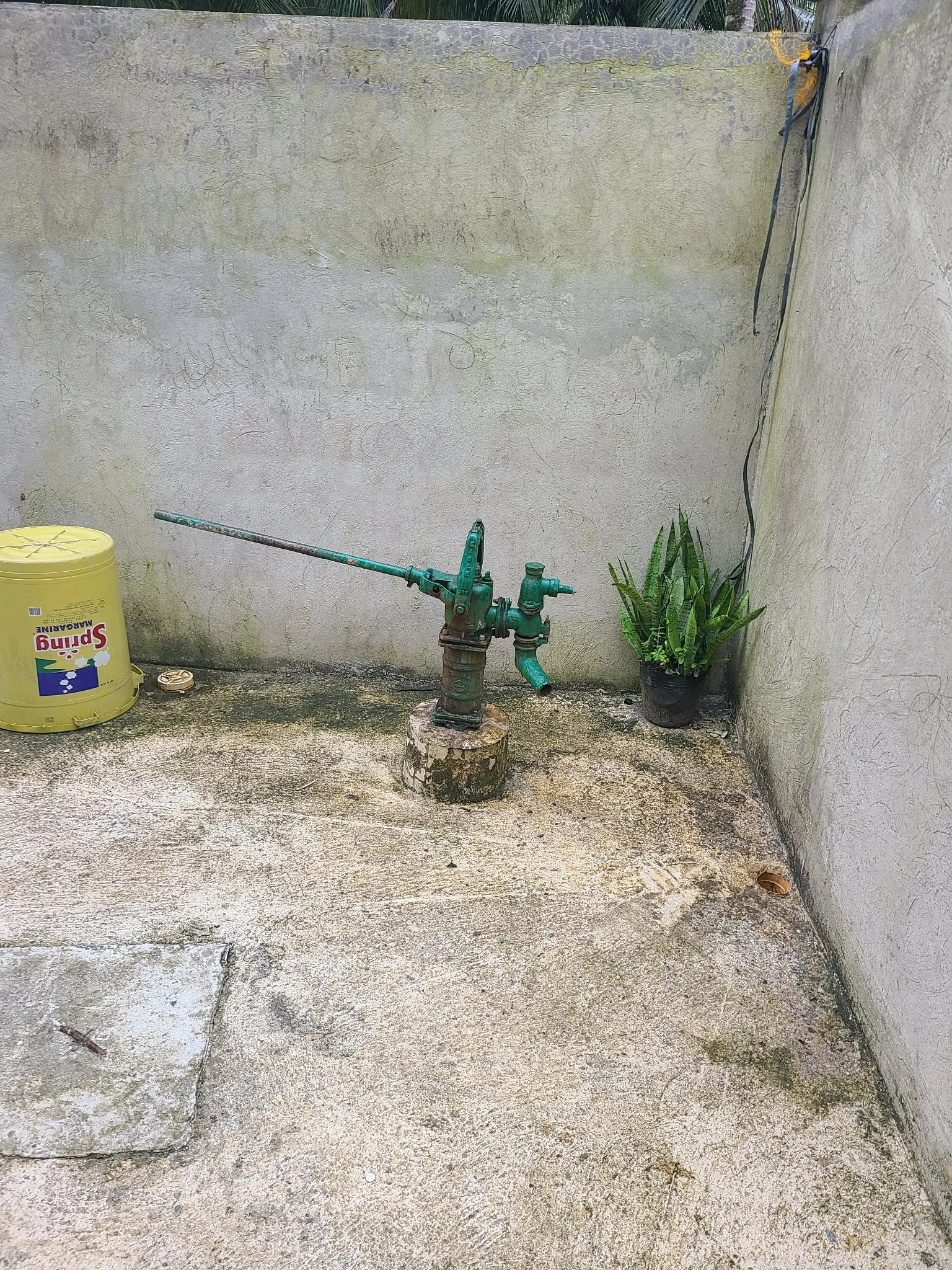
Once the house was built, we added an electric well pump. If the power is out, we still have the manual pump to get water from the well. More about that shortly. You can see the little-house-on-the-prarie manual well pump in the following photo. If the power is out, there is still a manual well-pump. The concrete block with a metal handle on it is the cover for the 75cm whole where the well mechanical bits and the actual pipe coming out of the ground are located.
If I had all this to do over again, I’d hire a professional company to drill the well—and go plenty deeper than just where they initially hit water. I suspect in a few years we will be digging out that well again—excuse me, “drilling” that well again. If you are in a position where you are building a well in the provinces, I’d strongly encourage you to hire a professional company. If one is not available (very possible), then keep the following in mind when hand-digging a well in the Philippines (or anywhere really):
1. Underground Collapse (The #1 Killer)
Hand-dug wells collapse fast, especially in:
- Sandy soil
- Soft clay
- Water-logged areas
- Areas near rivers or rice fields
If the walls aren’t immediately shored up with concrete rings or timber, you’re essentially digging your own grave.
Rule: As soon as you reach 2–3 feet below ground, install proper shoring. No exceptions.
2. Drowning / Sudden Water Breakthrough
Hitting the water table can cause a rapid surge of water and liquefied soil.
You can be:
- Buried
- Pinned
- Or drowned in murky slurry
This happens faster than people expect.
- Toxic / Low-Oxygen Air Deep holes can accumulate:
- Carbon dioxide
- Methane
- Hydrogen sulfide
- Rotten-egg sewer gases from decaying organic matter
You won’t smell most of it until you pass out like an idiot.
Rule: Use a gas test or at least lower a candle — if it dies, you will too.
- Septic Tank Proximity (Huge Problem in PH)
Most septic tanks in the Philippines are:
- Unlined
- Leaky
- Way too close to wells
Digging near a septic tank means you’re creating a direct pathway for contaminated water to enter a future drinking source.
Rule: Keep at least 15 meters (ideally more) distance from any septic system.
5. Weak Surface Soil From Monsoon Rains
- The rainy season turns upper soil layers into soggy pudding.
- This increases collapse risk dramatically.
- If it just rained? Don’t dig. Period.
6. Dangerous Depths
Most hand-dug wells in the Philippines are 20–60 feet deep.
Anything deeper becomes:
- Structurally unstable
- Prone to collapse
- Hard to ventilate
- Hard to extract workers in emergencies
Even pros limit hand-dug wells to safe depths.
7. Lack of Proper Lining
A well without proper linings is just a cave waiting to kill someone.
You want concrete rings, mortar-sealed, lowered as you dig.
Do NOT rely on:
- Bamboo
- Old plywood
- Makeshift metal sheets
- “Bahala na” engineering
8. Hitting Boulders or Hard Strata
Blunt reality:
- If you hit large boulders, hard bedrock, or thick gravel layers, you’re done.
- Hand digging through that is not realistic (or safe).
9. Contamination From Surface Water
A hand-dug well is extremely vulnerable to:
- Floodwater
- Runoff
- Animal waste
- Farm chemicals
- Nearby garbage pits
If the well is not sealed properly, everything on the surface eventually ends up in your drinking water.
10. Equipment Hazards
Common injuries include:
- Falling tools
- Rope-bucket failures
- Ladder slips
- Falling debris from top workers
- No helmet use
A hand-dug well is a construction site — but most rural crews treat it like a backyard project.
11. Water Testing (Most People Forget This)
Even if the well “looks clean,” groundwater may contain:
- E. coli
- Coliform
- Nitrates from farms
- Arsenic (in some regions)
- Saltwater intrusion (common near coasts)
You need initial and routine water testing.
12. Local Regulations / Permits
In many municipalities:
- Domestic shallow wells are allowed,
- But deeper wells require permits,
- And some LGUs ban new wells due to aquifer depletion.
If you drill illegally and neighbors’ wells run dry, they will absolutely blame you.
13. Heat & Exhaustion
Wells are hot, humid, and low-oxygen.
Many diggers pass out before anything else kills them.
14. Emergency Extraction Plan
If someone faints or is buried, you need:
- A hoist or tripod
- Safety harness
- People trained in confined space rescue
Most hand-dig operations have none of this.
Warning: Hand-digging a well is a high-risk confined-space excavation, not a weekend project.
People die doing this every year in tropical countries.
Our House Water System
I already talked about our water well earlier in this post. The well is located on the opposite side of the property from the septic tanks. All of the water for the house including sinks, showers, bathtubs, and outdoor spigots comes from the water well.
The water pump on the first floor pumps water from the well into the tank on the second floor. You can see the first floor water pump enclosure and the breaker switch in the next picture.
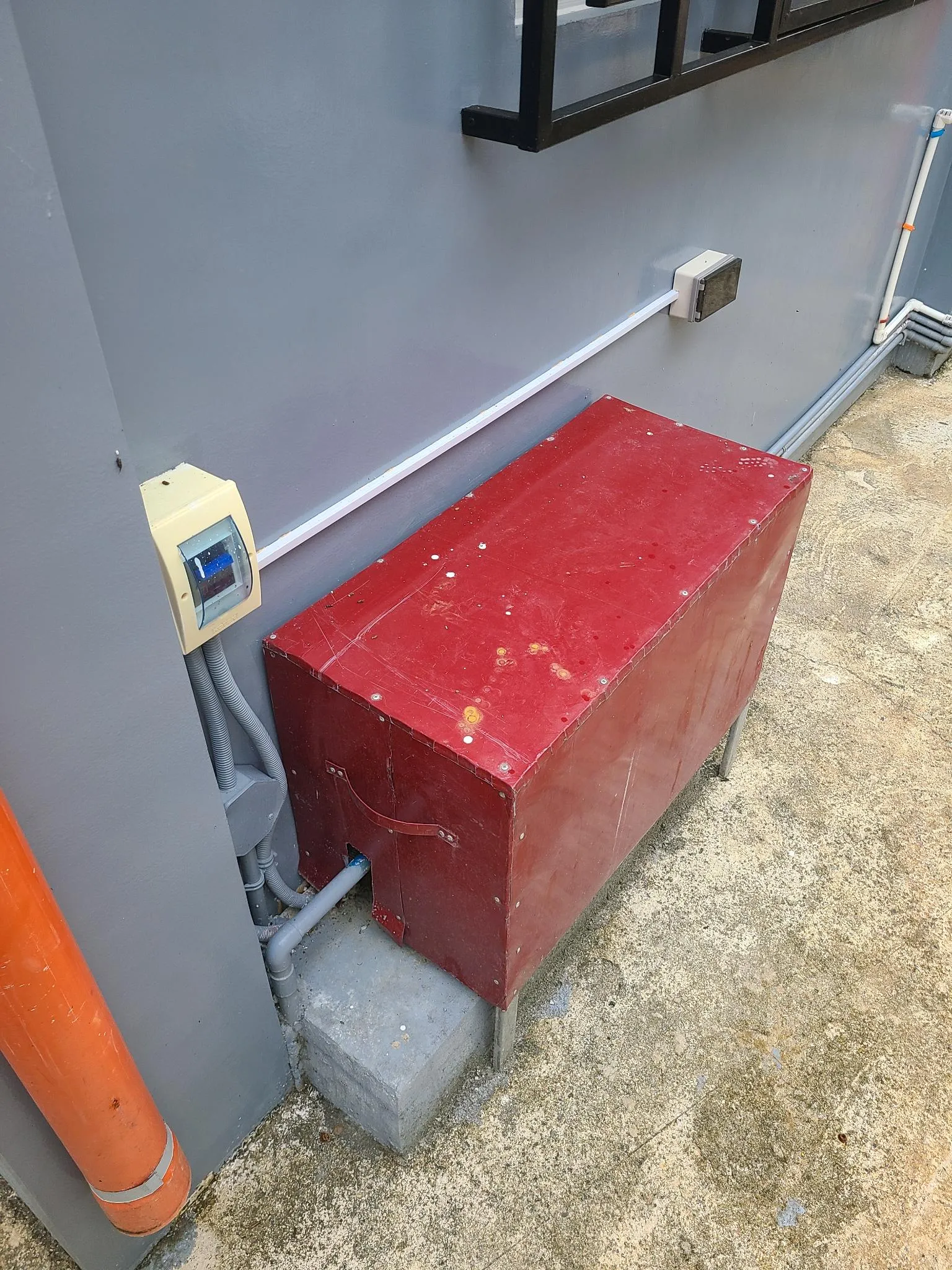
This water pump is a Eurostar DJM75 (¾ horsepower, 220V; 60hz; 3.8Amp; 3450 RPM)—made in Italy. They built the enclosure around the pump and pressure tank after it was installed.
This pumps water into the 2000L tank we have on the second floor. You can see the tank in the following photo.
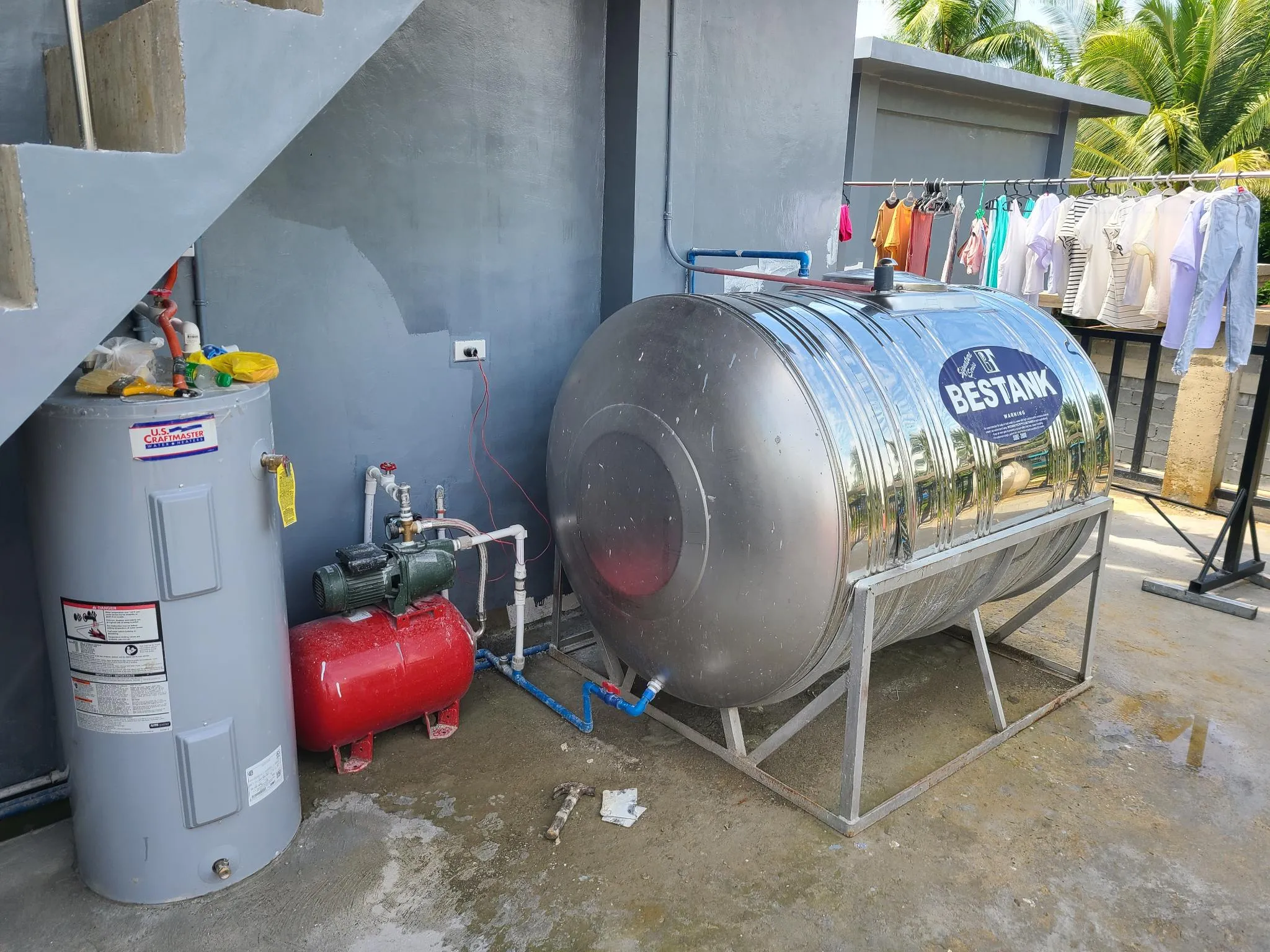
All of this equipment is protected from the rain and sun by a concrete overhang that is part of the roof.
Since this photo was taken, we installed a breaker switch similar to the one on the first floor.
Water enters the holding tank at the top.
You can also see the second water pump in the photo above. This is another Eurostar pump (same specs as the first pump). In order for the upstairs bathroom fixtures to work properly, a second pump was needed. The hot water heater provides hot water to the sink, shower, and bathtub to the upstairs bathroom.
Later, we added a Whole House Water Purifier / Filter to remove sediment and some of the other nasties from the well water. It can filter 3000L/h. So far, that has been sufficient for our needs. You can see the water filter installed in the next photo:
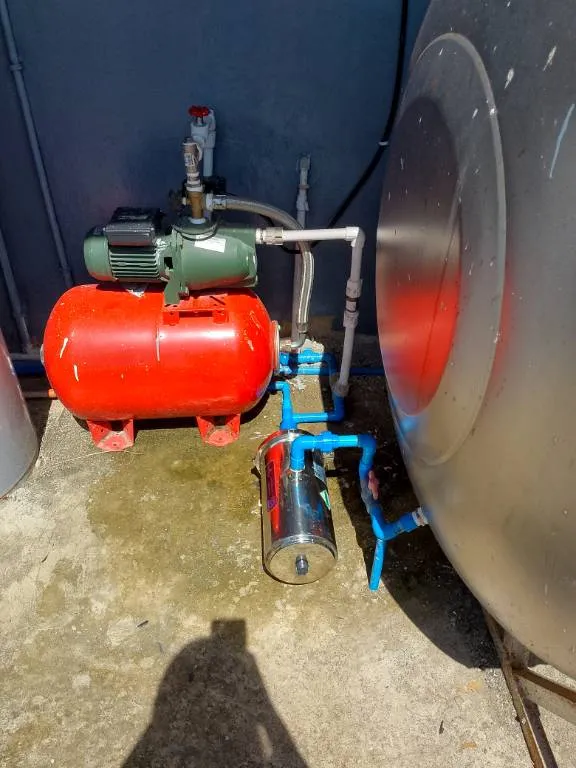
The water filter element needs to be scrubbed by hand every few months to clean it up. It turns the color of rust orange after a bit of use. The Shopee link above has a video of the filter element cleaning process.
The filter feeds into the various water fixtures in the kitchen and bathrooms. The most interesting of which is probably the hot water heaters for the downstairs bathrooms. You can see those in the next photo:
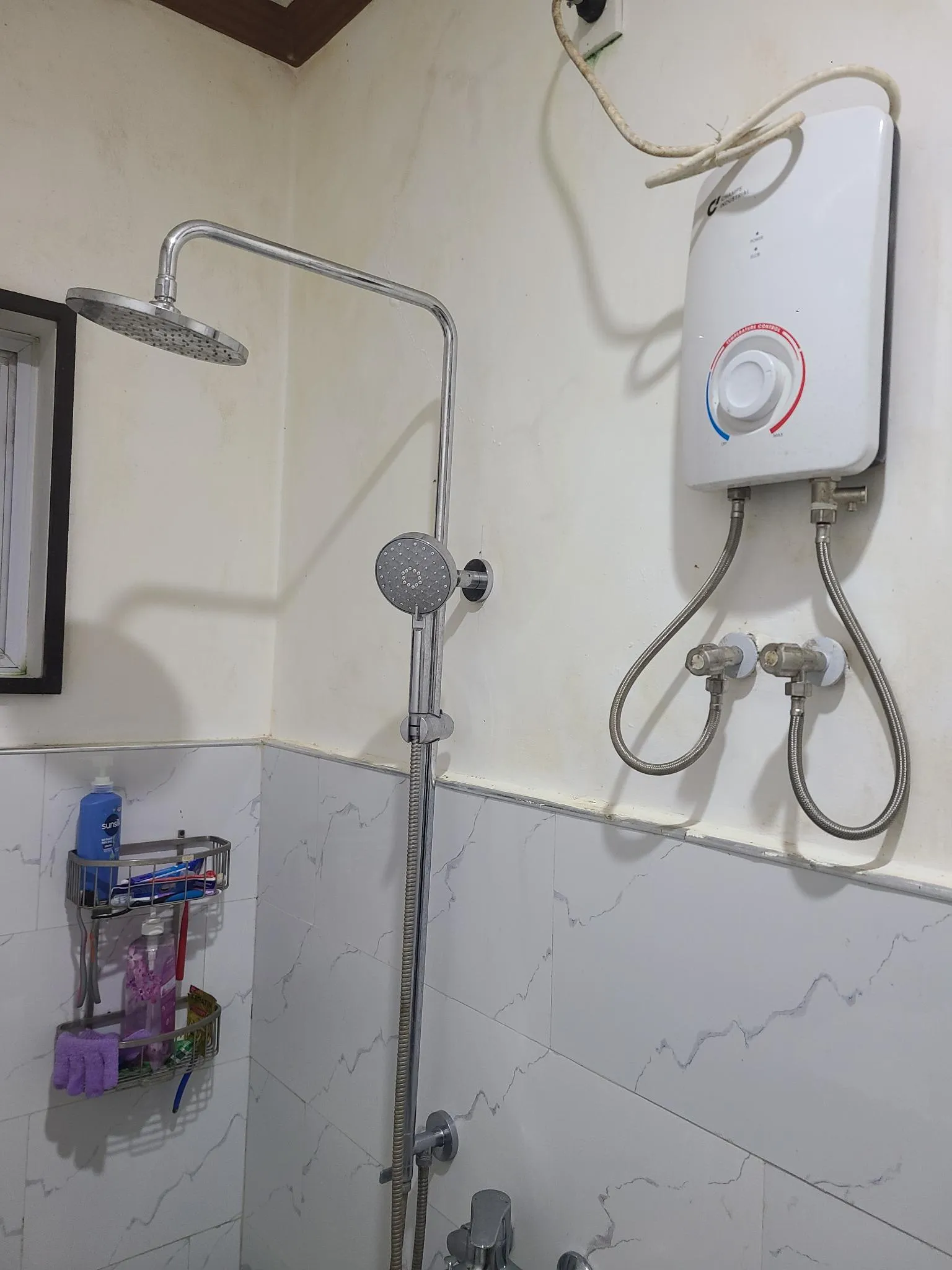
The bathroom floor is sealed and meant to get wet. There is a drain at the lowest point of the floor. Each bathroom has a squeege and gets cleaned on a regular bases. It’s fairly common to have an open shower model like this. For people coming from North America, this probably seems unusual. It took me a bit of time to get used to it
Our Drinking Water
The most cost effective drinking water solution is to buy it from the local water refill stations. There are a couple of local vendors that sell blue jerry cans filled with water—this is common in the rural areas.
We can also boil the filtered well-water, but this does use a notable amount of electrical power. However, if a typhoon or other natural disaster is upon us, it’s a usable option (even if on generator or battery). We have a hot pot for easily boiling water.
####Contaminated Water
To Conclude our water discussion, here’s what happens when you drink contaminated water.
Remember, just because the locals can drink it safely doesn’t mean that you (the foreigner) can.
1. Diarrhea (the classic “you messed up” symptom)
The most common sign.
If your stomach suddenly turns into a washing machine set to spin cycle, congratulations — you drank bacteria soup. Expect:
- Frequent watery stool
- Stomach cramps
- Urgency (as in, sprinting to the toilet like you’re in the SEA Games)
2. Nausea & Vomiting
Your body’s emergency protocol:
“Get this trash OUT.”
If your stomach ejects its contents, that’s a big sign something nasty was in your water.
3. Fever and Chills
A contaminated-well cocktail full of E. coli, salmonella, or other pathogens can cause fever.
If you’re shivering under a blanket in the tropics, yeah — that’s not normal.
- Abdominal Pain
Sharp, cramping, twisting pains usually mean bacterial or parasitic contamination.
- Dehydration (the evil plot twist)
You lose fluids from diarrhea/vomiting, then you get dehydrated, then you drink more contaminated water because you’re thirsty.
And the cycle continues.
Symptoms include:
- Dry mouth
- Dizziness
- Dark urine
- Weakness
Summary
Be safe. Filter and boil water before drinking it.
Thinking of Moving to the Philippines? Get Reliable Guidance.
Online communities are helpful for general questions. For anything important, you still need accurate, professional, and updated information. E636 Expat Services helps foreigners with:
- Residency and long term visas
- Bank account opening
- Health insurance guidance
- Real estate assistance
- Business setup
- Retirement planning
- A smooth and secure transition into life in the Philippines
If you want to move with confidence instead of relying on random comments online, we can guide you every step of the way.
Book a consultation with E636 and start your journey the right way.